✅ Authentic & Original Products | ⭐ Trusted by Thousands | 💵 Cash on Delivery | 🚚 Pan India Delivery | 🔒 Secure Payments
✅ Authentic & Original Products | ⭐ Trusted by Thousands | 💵 Cash on Delivery | 🚚 Pan India Delivery | 🔒 Secure Payments




Garba and Dandiya 2026: Dates, the Difference Between Them, and Steps for Anyone Starting Out
Garba and Dandiya 2026: Dates, the Difference Between Them, and Steps for Anyone Starting Out
Garba runs through Navratri from Sunday, 11 October to Monday, 19 October 2026, nine nights of it, and in Gujarat the state effectively reorganises itself around the evenings.
This guide covers what garba actually is, how it differs from dandiya raas, the basic steps for anyone joining for the first time, and what to wear.
What Garba Is
The name comes from garbha, meaning womb. At the centre of a traditional garba stands the garbo, an earthen pot perforated with holes, with a lamp burning inside it.
That image is the whole thing. The pot is the body, the lamp within it is the divine spark, and the light escaping through the holes is what that spark shows of itself. The dancers circle it because the circle has no beginning or end, which is the point being made about time and about the goddess at its centre.
Garba is danced around that centre, and traditionally it is danced by women, though modern garba grounds are mixed and have been for decades.
Garba and Dandiya Are Not the Same Thing
This confuses almost everyone outside Gujarat, and the distinction is real.
Garba is danced with the hands, using claps, and moves in circles around the central lamp. It is devotional in origin, performed before the aarti, and its rhythm builds gradually across the night. Taali garba, using claps, and be taali, the two-clap form, are the common variants.
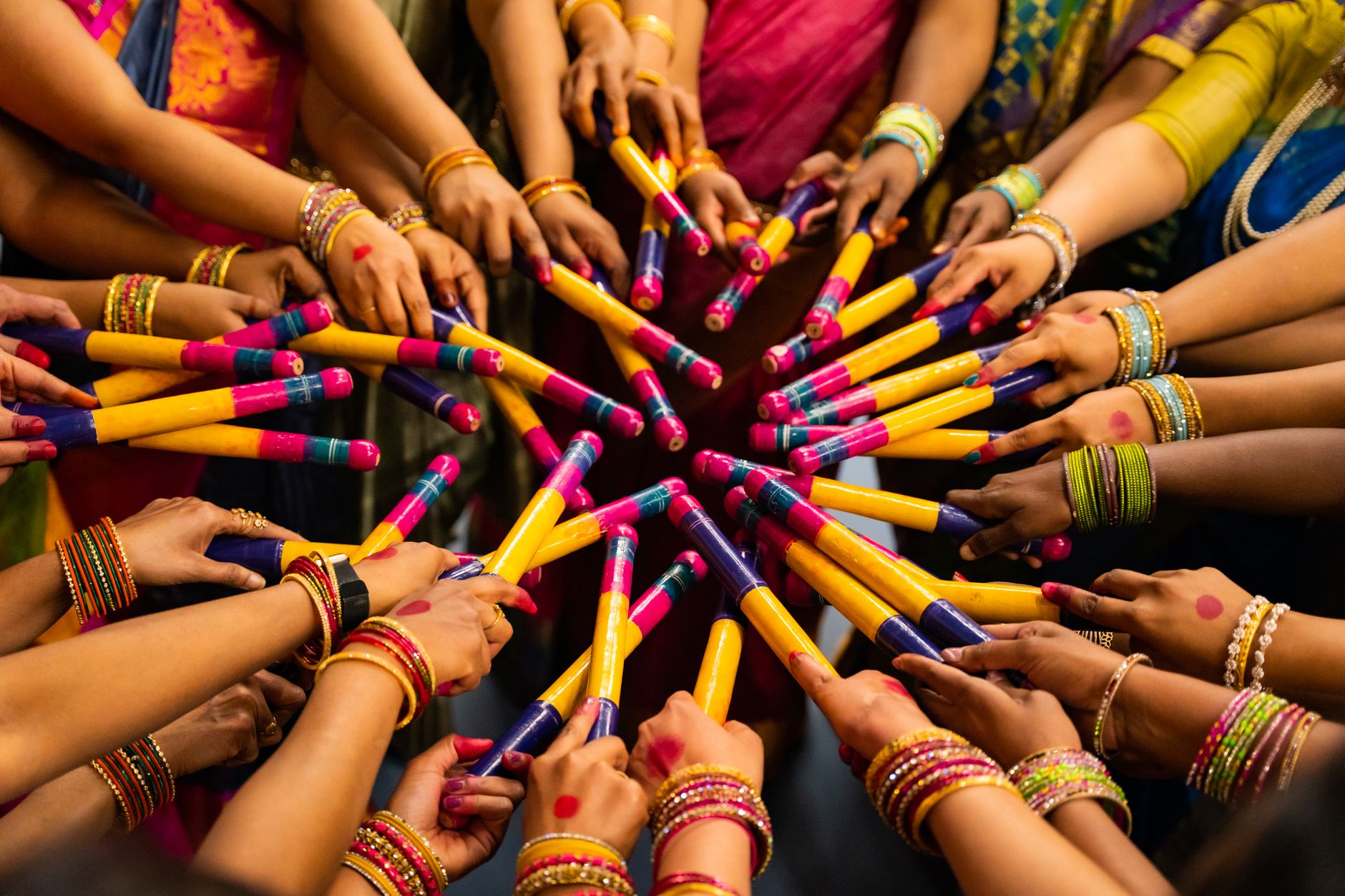
Dandiya raas is danced with sticks, in pairs, usually in two facing lines that rotate so partners change continuously. It depicts the battle between Durga and Mahishasura, with the sticks representing her sword. It follows the aarti rather than preceding it.
The traditional sequence across an evening: garba first, then aarti, then dandiya raas afterwards. Many commercial events collapse this, but the older order still holds in community grounds.
Basic Steps for Beginners
If you have never danced garba, this is genuinely learnable in one evening. Nobody is watching you as closely as you fear, and the circle carries you.
The two-clap (be taali). The foundation. Step right, bring the left foot across, clap. Step left, bring the right across, clap. The whole circle moves anticlockwise. Watch the feet of the person ahead and follow.
The three-clap (trann taali). The same movement with an extra beat: two steps, then a clap low, a clap at chest, and a clap above. Faster and more common as the night builds.
Hinch. A simpler, faster, low-effort step used when the tempo rises and everyone is tired. Small steps, minimal arms, sustained for long stretches.
Sanedo and popular styles. Later in the night, faster folk styles take over and the form loosens considerably.
Practical advice for a first night: join the outer circle rather than the inner one, since the outer ring moves more slowly and forgives mistakes. Arrive early while the tempo is still gentle. And do not try to learn dandiya before garba, because the stick work with a changing partner is considerably harder.
Dandiya Etiquette
A few things worth knowing before you pick up sticks.
Strike the partner’s sticks, not the partner. Keep the strike at chest height and controlled. The lines rotate, so you will change partners every few beats, and holding up the rotation is the one real faux pas. If you lose the rhythm, step out of the line rather than stopping in it.
What to Wear
Chaniya choli is the traditional women’s dress: a flared skirt, fitted blouse and dupatta, usually with mirror work, bandhani or embroidery. The flare matters, because it is what the twirl is for.
Kediyu and dhoti for men, the short pleated upper garment with churidar or dhoti, often with a kediyu jacket and pagdi.
Jewellery is heavy and deliberate: oxidised silver, kamarbandh, jhumkas, bajubandh, layered necklaces, and bangles that make sound as you move. The sound is part of it.
The daily colour. Most Garba grounds coordinate to the nine-colour sequence, so entire venues turn a single shade each night. Our Navratri 2026 colours guide has the full list with dates.
Footwear. The one practical thing people get wrong. You will dance for four or five hours on hard ground. Mojris or flat juttis, worn in advance rather than new, are the sensible choice. Heels do not survive night three.
Accessories and Stones
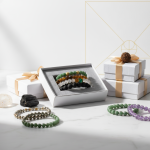
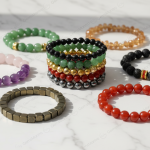
Many people match jewellery to the day’s colour, and stone bracelets are an easy way to do it without changing the whole outfit. Carnelian for orange, moonstone for white, red jasper for red, lapis lazuli for royal blue, citrine for yellow, green aventurine for green, amethyst for purple.
Our crystal bracelet collection covers these, and stretch-fit bracelets stay on through several hours of dancing better than clasped jewellery does.
For anyone wanting something matched to their sign rather than the day, our zodiac bracelet range and the rashi bracelet guide cover that.
Practical Notes for Nine Nights
Garba is physically demanding in a way people underestimate. Four hours of continuous dancing, nine nights running, often on an empty stomach if you are fasting.
Drink water between rounds even when you are not thirsty. If you are keeping the Navratri fast, be sensible about combining it with a full night of dancing, and step out when you need to. Every year Garba grounds see people faint from the combination.
Grounds in Ahmedabad and across Gujarat run late, often past midnight. Arrange your return before you go, since finding transport at 2 AM during Navratri is its own ordeal.
Frequently Asked Questions
When is Garba in 2026?
Garba runs through the nine nights of Sharad Navratri, from Sunday 11 October to Monday 19 October 2026, with Dussehra following on 20 October.
What is the difference between garba and dandiya?
Garba is danced with claps, in circles around a central lamp, and is devotional in origin, traditionally performed before the aarti. Dandiya raas is danced with sticks in pairs, usually in facing lines with rotating partners, depicting Durga’s battle with Mahishasura, and follows the aarti.
How can a beginner learn garba quickly?
Start with the two-clap step: step right, bring the left foot across, clap, then step left, bring the right across, clap, moving anticlockwise. Join the outer circle, which moves more slowly, and arrive early while the tempo is still gentle. Follow the feet of the person ahead.
Why is garba danced in a circle?
The circle has no beginning or end, representing the cyclical nature of time and the goddess at its unmoving centre. At the centre stands the garbo, a perforated earthen pot with a lamp inside, symbolising the body and the divine spark within it.
What should be worn for garba?
Chaniya choli for women, a flared skirt with fitted blouse and dupatta, and kediyu with dhoti or churidar for men. Oxidised silver jewellery is traditional. Most grounds coordinate to the daily Navratri colour. Wear flat, broken-in footwear rather than heels.
What is the earthen pot at the centre of a garba called?
The garbo, a clay pot perforated with holes and holding a lit lamp. The word garba derives from garbha, meaning womb, and the pot represents the body with the divine spark within it.
Nine Nights on the Ground
Garba is the rare festival practice that asks for nothing but your presence in a circle, and rewards it with the best nine evenings of the Gujarati year.
Our Navratri 2026 guide covers the nine Devi forms and the observance, and the colours guide has the daily list.
Festival dates follow tithi and may vary by a day depending on your local panchang. Garba is physically demanding; take care when combining it with fasting, and stay hydrated.