✅ Authentic & Original Products | ⭐ Trusted by Thousands | 💵 Cash on Delivery | 🚚 Pan India Delivery | 🔒 Secure Payments
✅ Authentic & Original Products | ⭐ Trusted by Thousands | 💵 Cash on Delivery | 🚚 Pan India Delivery | 🔒 Secure Payments






Rashi Bracelet: The Complete Guide to Choosing the Right Crystal Bracelet for Your Zodiac Sign
Rashi Bracelet: The Complete Guide to Choosing the Right Crystal Bracelet for Your Zodiac Sign
Every week we get the same question on WhatsApp: “Which bracelet is right for my rashi?” It sounds simple, but the honest answer involves a few things most sellers skip over, including which system of astrology you are actually using and whether the stone you have been recommended matches your moon sign or your sun sign. Those are not the same thing, and picking the wrong one is the most common mistake we see.
This guide covers what a rashi bracelet is, which stones belong to each of the twelve signs, how to wear and care for one, and how to tell genuine crystal from dyed glass. It is written from what customers actually ask us, rather than from what ranks well.
What Is a Rashi Bracelet?
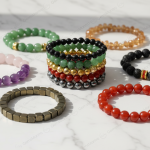
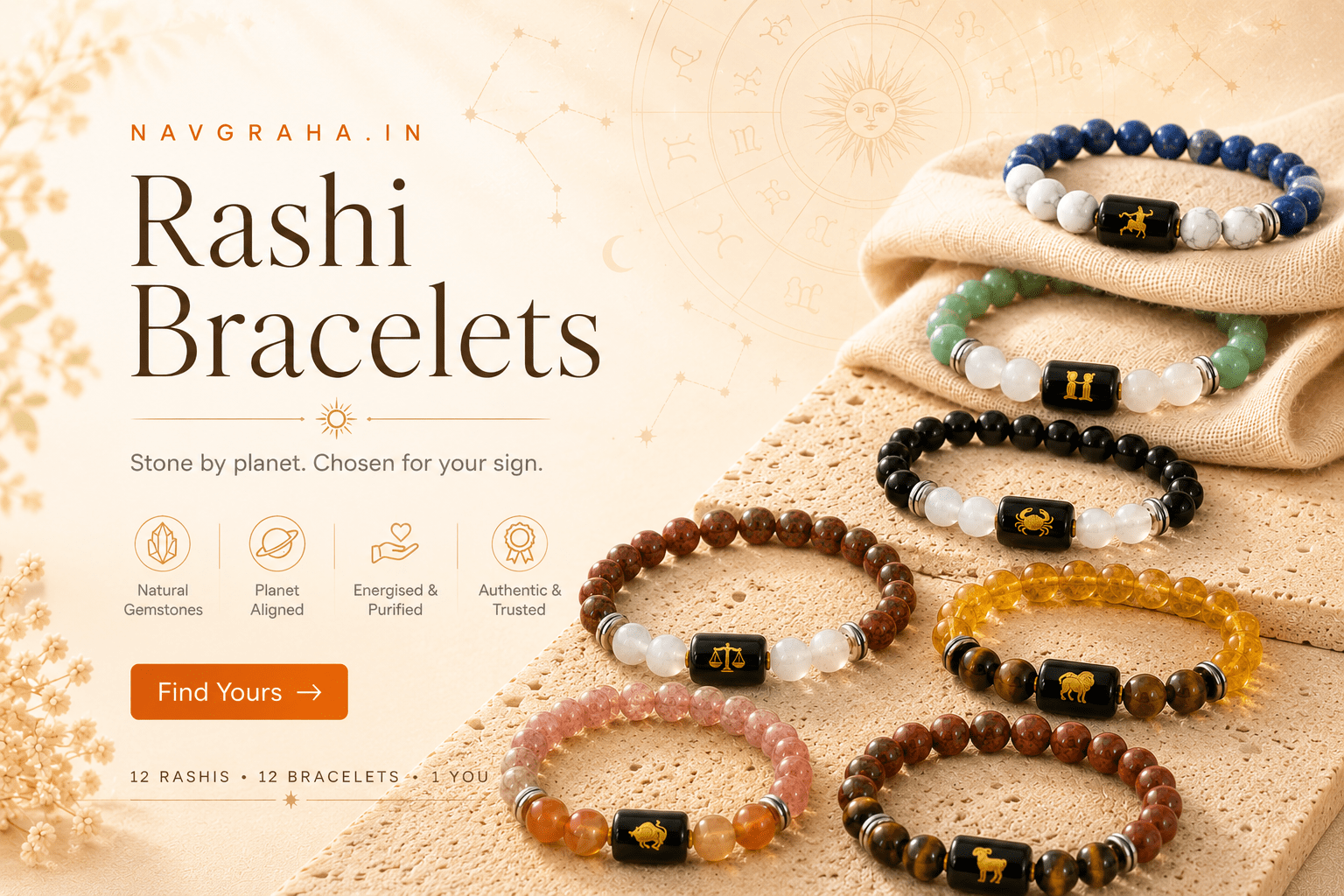
A rashi bracelet is a beaded bracelet made from natural crystals or gemstones chosen to correspond with a particular zodiac sign. In Vedic astrology, each rashi is governed by a ruling planet, and each planet has traditionally been associated with specific stones. A rashi bracelet gathers those stones into something you can wear daily.
The idea rests on a simple principle from Vedic thought: the qualities of a planet are believed to be carried in certain materials, and keeping those materials close is a way of staying connected to that influence. Whether you approach this as astrology, as tradition, or simply as a meaningful object you like wearing, the practice is the same.
Compared with a gemstone ring, which usually carries one large certified stone set in a specific metal and is prescribed after a chart reading, a bracelet is a gentler, more accessible option. It requires no chart, no muhurat, and no significant expense, which is why it has become the entry point for most people exploring astrological remedies.
Rashi or Zodiac Sign? The Difference That Trips Everyone Up
This is the single most useful thing in this article, so it comes early.
When someone in India says “my rashi,” they usually mean their Vedic moon sign, calculated from the position of the Moon at birth using the sidereal zodiac. When a horoscope app or a magazine says “your zodiac sign,” it almost always means the Western sun sign, based on the Sun’s position using the tropical zodiac.
These two systems currently differ by roughly 24 degrees, which means your Vedic rashi is frequently the sign before your Western one. Someone born on 20 April is Taurus by Western reckoning but often Aries by Vedic calculation. Add the moon-versus-sun difference and the two can diverge considerably.
So which should you use for a bracelet? Follow whichever tradition you actually practise. If your family consults a Vedic astrologer and you know your janma rashi from your kundli, use that. If you have grown up reading Western horoscopes and identify with that sign, use that instead. What matters most is consistency, since wearing stones for two different signs at once defeats the purpose.
If you are unsure, your birth certificate time plus any free Vedic calculator will give you your moon rashi in under a minute. Our 2026 horoscope guide covers the year ahead for each sign in more detail.
Stones for All Twelve Rashis
Below is the correspondence we use when building bracelets, along with the ruling planet for each sign. Each of our zodiac bracelets pairs two complementary stones rather than one, because a single stone tends to emphasise one quality while leaving others unsupported.
Fire Signs
Aries (मेष राशि), ruled by Mangal (Mars). Red Jasper and Tiger Eye. Red Jasper steadies the restlessness that comes with a Mars-ruled sign, while Tiger Eye channels the natural drive into sustained action rather than short bursts. See the Aries rashi bracelet.
Leo (सिंह राशि), ruled by Surya (Sun). Tiger Eye and Citrine. Tiger Eye holds confidence steady when attention is on you, and Citrine keeps ambition warm rather than forceful.
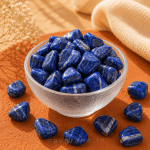
Sagittarius (धनु राशि), ruled by Guru (Jupiter). Citrine and Lapis Lazuli. Citrine supports the expansive Jupiter quality, while Lapis brings the focus that keeps enthusiasm from scattering.
Earth Signs
Taurus (वृषभ राशि), ruled by Shukra (Venus). Rose Quartz and Green Aventurine, pairing Venusian warmth with steady material growth.
Virgo (कन्या राशि), ruled by Budh (Mercury). Green Aventurine and Amazonite, which soften the self-critical streak that often accompanies a Mercury-ruled earth sign.
Capricorn (मकर राशि), ruled by Shani (Saturn). Black Tourmaline and Garnet. Tourmaline grounds Saturn’s weight, and Garnet keeps energy from flattening under long effort. Our natural garnet bracelet works well alongside it.
Air Signs
Gemini (मिथुन राशि), ruled by Budh (Mercury). Clear Quartz and Blue Lace Agate, supporting mental clarity and calmer communication.
Libra (तुला राशि), ruled by Shukra (Venus). Rose Quartz and Lapis Lazuli, balancing the Libran instinct to please with the ability to decide.
Aquarius (कुंभ राशि), ruled by Shani (Saturn). Amethyst and Lapis Lazuli, for emotional awareness and mental calm. See the Aquarius rashi bracelet.
Water Signs
Cancer (कर्क राशि), ruled by Chandra (Moon). Howlite and Milky Quartz, both chosen for emotional steadiness in a sign that feels everything strongly.
Scorpio (वृश्चिक राशि), ruled by Mangal (Mars). Black Obsidian and Carnelian, pairing protective grounding with vitality. Our carnelian bracelet is a good standalone option too.
Pisces (मीन राशि), ruled by Guru (Jupiter). Amethyst and Moonstone, which support intuition without tipping into overwhelm. Many Pisces wearers also choose our moonstone bracelet separately.
How to Wear a Rashi Bracelet
Traditional practice offers clear guidance here, and it comes down to which direction you want the energy to move.
Left wrist to receive. The non-dominant hand is considered the receiving side. Wear your bracelet here if you want to absorb the qualities of the stones, which is what most people want from a rashi bracelet.
Right wrist to project. The dominant hand is the giving side. Choose this if you want the stone’s energy to influence how you act outward, which suits protective stones like Black Tourmaline and Black Obsidian.
A few practical points. Wear it consistently rather than occasionally, since traditional practice treats this as a daily connection rather than an occasional one. Remove it while showering, swimming or sleeping, because soap residue dulls the beads and elastic degrades faster when wet. Give it a few weeks before judging the effect, since nothing in this tradition claims to work overnight.
Cleansing and Charging
Crystals are traditionally believed to accumulate the energy around them and to need periodic clearing. This is where most new owners neglect their bracelet, and it is the easiest part of the practice to get right.
Selenite is the simplest method. Selenite is the one stone traditionally considered self-cleansing, which is why it can clear other stones without needing clearing itself. Rest your bracelet on a selenite plate overnight and it is ready by morning. Every bracelet we sell ships with a free raw selenite charging plate for exactly this reason, so you do not need to buy anything extra.
Moonlight. Leave the bracelet on a windowsill during a full moon night. Gentle, effective and free.
Incense or dhoop. Pass the bracelet through the smoke of sandalwood, loban or your usual dhoop a few times.
Two things to avoid. Do not leave coloured stones like Amethyst, Rose Quartz or Citrine in direct sunlight for long periods, since the colour fades permanently. And do not soak porous stones such as Howlite, Turquoise or Selenite in water, because they will degrade.
Cleanse roughly once a month, or sooner after a difficult period, an illness in the house, or heavy travel.
Five Common Mistakes
Mixing signs. Wearing your rashi bracelet alongside a friend’s or a different sign’s bracelet works against the specificity that made you choose one in the first place.
Stacking too many bracelets. Two or three complementary pieces are fine. Eight competing ones give you an armful of stones with no clear intention behind any of them.
Never cleansing. A bracelet worn daily for a year without a single cleansing is the most frequent oversight we hear about.
Buying dyed glass. More on identifying this below, because it is worth its own section.
Expecting the stone to do the work. Traditional practice treats these as supports for your own effort and intention, not substitutes for either. Anyone promising guaranteed outcomes is selling something other than tradition.
How to Tell Genuine Crystal from Dyed Glass
The market is full of dyed glass and reconstituted stone sold as natural crystal, often at prices close to the real thing. A few checks help.
Look for imperfection. Natural stone contains inclusions, cloudiness and colour variation between beads. Perfectly uniform, flawless beads at a low price are usually glass.
Check temperature. Natural crystal feels cool against the skin and warms slowly. Glass matches room temperature almost immediately.
Test the weight. Genuine stone feels heavier than it looks. Glass and plastic feel light for their size.
Be sceptical of impossible colours. Neon blue, vivid pink or electric green in a stone that is naturally muted almost always means dye.
Inspect the drill holes. Dye concentrates around the hole, so a darker ring there is a reliable giveaway.
Every bracelet in our crystal bracelet collection uses natural stone, and each one is cleansed before dispatch.
Bracelet, Ring or Something for the Home?
People often ask which format suits them, and it depends on what you want.
A rashi bracelet costs around ₹599, needs no chart reading, and is worn daily. It is the natural starting point.
A certified gemstone ring is a considerably larger commitment, typically prescribed by an astrologer after examining your chart, with rules about metal, finger and timing. Our certified gemstones serve this purpose.
A crystal tree or vastu item works on the space rather than the person, which suits households where several people want the benefit. The Navgraha Crystal Tree carries stones for all nine planets and is popular for exactly that reason.
If you want both a personal and a household piece, the Navgraha Special Combo pairs the tree with a matching bracelet and a selenite plate.
Frequently Asked Questions
Can I wear a rashi bracelet every day?
Yes, and daily wear is what traditional practice recommends. Remove it for bathing, swimming and sleeping to protect the beads and elastic.
Which hand should I wear it on?
Left for receiving the stone’s qualities, which suits most purposes. Right for projecting outward, which suits protective stones.
Can I wear two rashi bracelets together?
Wearing two bracelets for different signs is not recommended. Pairing your rashi bracelet with a purpose-specific one, such as a protection or prosperity bracelet, is fine.
How often should I cleanse it?
About once a month under normal use, and sooner after illness, heavy travel or a difficult period. A selenite plate overnight is the easiest method.
Does it work if I do not know my exact birth time?
Your moon rashi does need a reasonably accurate birth time. Without one, use your sun sign consistently instead, since a well-chosen bracelet worn with intention matters more than a precise calculation you cannot verify.
Are these suitable as gifts?
They are among our most gifted items, particularly for birthdays, since the sign is already known. Every bracelet includes a free selenite charging plate, which makes it a complete gift without anything else needed.
Where to Start
If you know your rashi, go straight to the zodiac bracelet collection and choose your sign. Every bracelet is made from natural stone, ships with a free raw selenite charging plate, and is available with cash on delivery across India.
If you would rather begin with a general-purpose stone before committing to a sign, the Tiger Eye bracelet suits nearly everyone and is our most versatile single-stone option.
Spiritual and astrological benefits described here are based on traditional beliefs and practices. Individual experiences vary according to personal faith, practice and intention. These products are not intended to diagnose, treat, cure or prevent any medical condition.