✅ Authentic & Original Products | ⭐ Trusted by Thousands | 💵 Cash on Delivery | 🚚 Pan India Delivery | 🔒 Secure Payments
✅ Authentic & Original Products | ⭐ Trusted by Thousands | 💵 Cash on Delivery | 🚚 Pan India Delivery | 🔒 Secure Payments










Tulsi Vivah 2026: Date, Vidhi and the Opening of Wedding Season
Tulsi Vivah 2026: Date, Vidhi and the Opening of Wedding Season
Tulsi Vivah falls on Saturday, 21 November 2026. It marks the ceremonial marriage of the Tulsi plant to Vishnu in his Shaligram form, and it opens the Hindu wedding season, which has been closed since Chaturmas began in July.
The observance can be performed from Prabodhini Ekadashi through to Kartik Purnima on Tuesday, 24 November, which is also Dev Deepawali. This guide covers both.
Why the Season Was Closed
Chaturmas, the four months of the monsoon, is the period Vishnu is said to spend in cosmic sleep. Through it, weddings, griha pravesh, mundan and other auspicious beginnings are traditionally set aside.
Prabodhini Ekadashi, also called Devuthani or Dev Uthani Ekadashi, is when he wakes. Tulsi Vivah follows immediately, and it functions as the first wedding of the season, performed before any human one.
From this point until roughly mid-December, and then again after Makar Sankranti, the calendar fills with weddings. If you have been waiting to move into a home, begin something, or fix a date, this is when the waiting ends.
The Story of Vrinda
The tradition rests on a story that is more complicated than most, and worth telling honestly.
Vrinda was a woman of extraordinary devotion, married to the asura Jalandhara. Her devotion was such that it made him invincible, and no god could defeat him while she remained faithful.
Unable to overcome him otherwise, Vishnu took Jalandhara’s form and appeared before Vrinda. Believing him to be her husband, she received him, and in that moment her chastity was broken and Jalandhara fell in battle.
When Vrinda understood what had happened, she cursed Vishnu to become a stone, which is the origin of the Shaligram. Then she gave up her life, and from her ashes grew the Tulsi plant.
Vishnu accepted the curse and declared that he would never receive worship without Tulsi being offered alongside, and that the two would be married each year in Kartik. Tulsi Vivah is the keeping of that promise.
The story is not a comfortable one, and traditional commentaries have wrestled with it for centuries. It is told here as the tradition tells it.
Performing Tulsi Vivah at Home
The ceremony follows the form of an actual wedding, and households treat it as one.
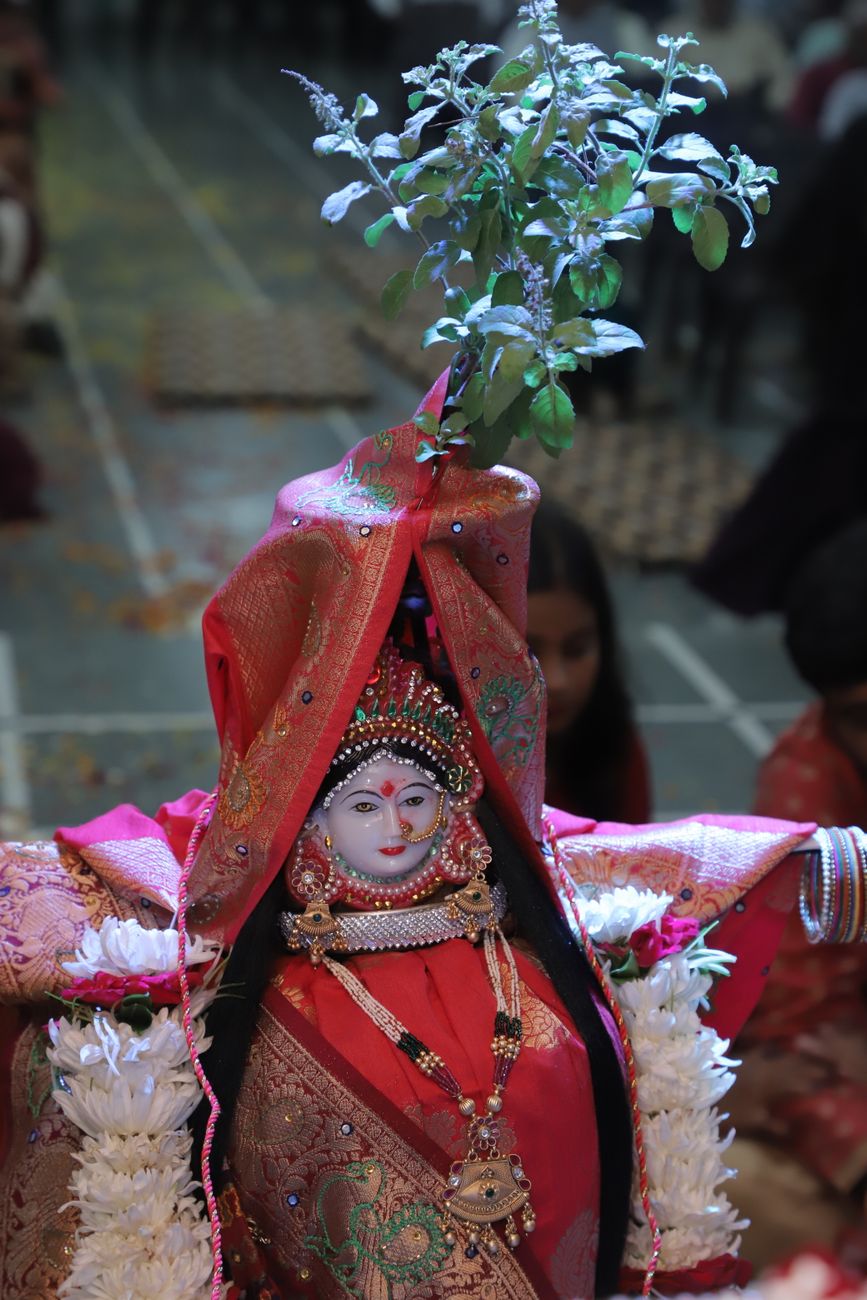
Preparing. Clean the courtyard or space around the Tulsi plant. Decorate the pot with rangoli, and drape it with a red or pink chunari. The plant is dressed as a bride, with bangles, bindi and jewellery placed at the base.
The groom. A Shaligram stone, or an image or small idol of Vishnu or Krishna, is placed beside the plant. Families without a Shaligram use a sugarcane stalk or an amla branch, both accepted substitutes.
The mandap. Four sugarcane stalks are set around the plant and tied at the top to form a canopy, exactly as a wedding mandap is raised.
The ceremony. Perform Ganesh puja first. Then conduct the vivah as a wedding: haldi applied to both, the exchange of garlands, a cloth held between the two and then lowered, the mangal ashtak sung, and finally the tying of a thread joining the plant and the Shaligram.
The offerings. Amla, sugarcane, seasonal fruit, sweets and a lit diya. Families often prepare the same food they would for a household wedding.
Closing. Aarti, then prasad distributed to neighbours as wedding prasad, which in many neighbourhoods is exactly how it is received.
Many households treat it as a full family occasion, with invitations sent and the courtyard lit.
Dev Deepawali and Kartik Purnima
Kartik Purnima falls on Tuesday, 24 November 2026, and carries several observances at once.
Dev Deepawali, the Diwali of the gods, is said to be when the devas descend to earth to celebrate Shiva’s victory over Tripurasura. Varanasi is where it is seen most spectacularly, with the ghats lined end to end with lamps, and lakhs of diyas set on the steps and floated on the Ganga.
Kartik Purnima is also Guru Nanak Jayanti in the Sikh tradition, and the concluding day of the Pushkar Fair in Rajasthan. It is the last day on which Tulsi Vivah may be performed.
A lamp lit at the Tulsi plant on this evening is among the oldest customs of the month, and the simplest way to mark the day at home.
Wedding and Housewarming Gifting
With the season opening, this is the point in the calendar when gifting shifts from festival to occasion.
For a couple setting up a home, entrance and household pieces are the practical choice. The Kirti Mukh and Navgraha Tree combo covers both the doorway and the interior, and our placement guide is worth passing on with it.
For the couple themselves, rashi bracelets matched to each of their signs make a paired gift that costs little and means more than a generic one. Rose Quartz is the traditional stone for a new marriage.
For the puja space of a new home, our brass deity idols and Pooja Essentials cover what a household needs to begin.
Frequently Asked Questions
When is Tulsi Vivah 2026?
Saturday, 21 November 2026. It may be performed from Prabodhini Ekadashi through Kartik Purnima on Tuesday, 24 November, which is the final day for the ceremony.
Why is Tulsi married to Shaligram?
According to the Puranic account, Vrinda cursed Vishnu to become a stone, the origin of the Shaligram, after he took her husband’s form. From her ashes grew the Tulsi plant, and Vishnu declared that he would never be worshipped without Tulsi offered alongside, and that the two would be married each year in Kartik.
Does wedding season begin with Tulsi Vivah?
Yes. Chaturmas, the four months when Vishnu is said to sleep, closes the calendar to weddings and other auspicious beginnings from July. Prabodhini Ekadashi is when he wakes, and Tulsi Vivah functions as the first wedding of the season, performed before any human one.
Can Tulsi Vivah be performed without a Shaligram?
Yes. A sugarcane stalk or an amla branch is an accepted substitute, as is an image or small idol of Vishnu or Krishna.
What is Dev Deepawali?
The Diwali of the gods, observed on Kartik Purnima, on 24 November in 2026. The devas are said to descend to earth to celebrate Shiva’s victory over Tripurasura. It is seen most spectacularly in Varanasi, where the ghats are lined with lamps.
What is offered during Tulsi Vivah?
Amla, sugarcane, seasonal fruit, sweets and a lit diya. The plant is dressed as a bride with a chunari, bangles and bindi, and four sugarcane stalks are tied above it as a mandap.
The Season Opens
Tulsi Vivah is a small ceremony with a large function. A plant in a courtyard, a stone beside it, four sugarcane stalks tied overhead, and a calendar that has been closed for four months opening again.
Our Chhath Puja guide covers the observance the week before, and the Diwali 2026 guide covers the festival that opened the month.
Ritual practices vary by region, community and family; follow your own household tradition where it differs. Festival dates follow tithi and may vary by a day depending on your local panchang. These products are not intended to diagnose, treat, cure or prevent any medical condition.