✅ Authentic & Original Products | ⭐ Trusted by Thousands | 💵 Cash on Delivery | 🚚 Pan India Delivery | 🔒 Secure Payments
✅ Authentic & Original Products | ⭐ Trusted by Thousands | 💵 Cash on Delivery | 🚚 Pan India Delivery | 🔒 Secure Payments












Lakshmi Puja 2026: Muhurat, Complete Vidhi and What Most Households Get Wrong
Lakshmi Puja 2026: Muhurat, Complete Vidhi and What Most Households Get Wrong
Lakshmi Puja falls on Sunday, 8 November 2026, on Kartik Amavasya. The puja is performed after sunset during Pradosh Kaal, roughly between 6:00 PM and 8:00 PM, with the exact window shifting by ten to twenty minutes depending on your city’s sunset.
This guide covers the full vidhi step by step, the samagri you need, the mantras, and the errors that quietly undermine an otherwise careful puja.
Why the Timing Matters
Lakshmi Puja is performed during Pradosh Kaal, the period beginning at sunset and lasting roughly two hours and twenty minutes. Within that, the Sthir Lagna, or fixed ascendant, is considered the most auspicious window, because a fixed sign is believed to keep Lakshmi settled in the home rather than passing through.
Amavasya, the new moon, must be current during the puja. In 2026 the tithi is comfortably placed on the evening of 8 November, so there is no ambiguity about the date this year.
Check a panchang for your own city rather than using a Delhi timing. Ahmedabad, Mumbai and Bengaluru all differ from Delhi by enough to matter.
Puja Samagri Checklist
Gather everything before you begin, since leaving the puja space to fetch something is traditionally avoided.
Idols or images: Lakshmi and Ganesha together. Ganesha is always worshipped first. Many households keep a dedicated set brought out only for Diwali.
For the seat: a wooden chowki, a red or yellow cloth, and rice to spread beneath the idols.
Kalash: a copper or brass pot, water, a coin, a supari, rice, five mango leaves, and a coconut to place on top.
Offerings: roli, haldi, akshat (unbroken rice), flowers with lotus if available, durva grass for Ganesha, panchamrit, sweets, fruit, batasha, and kheel.
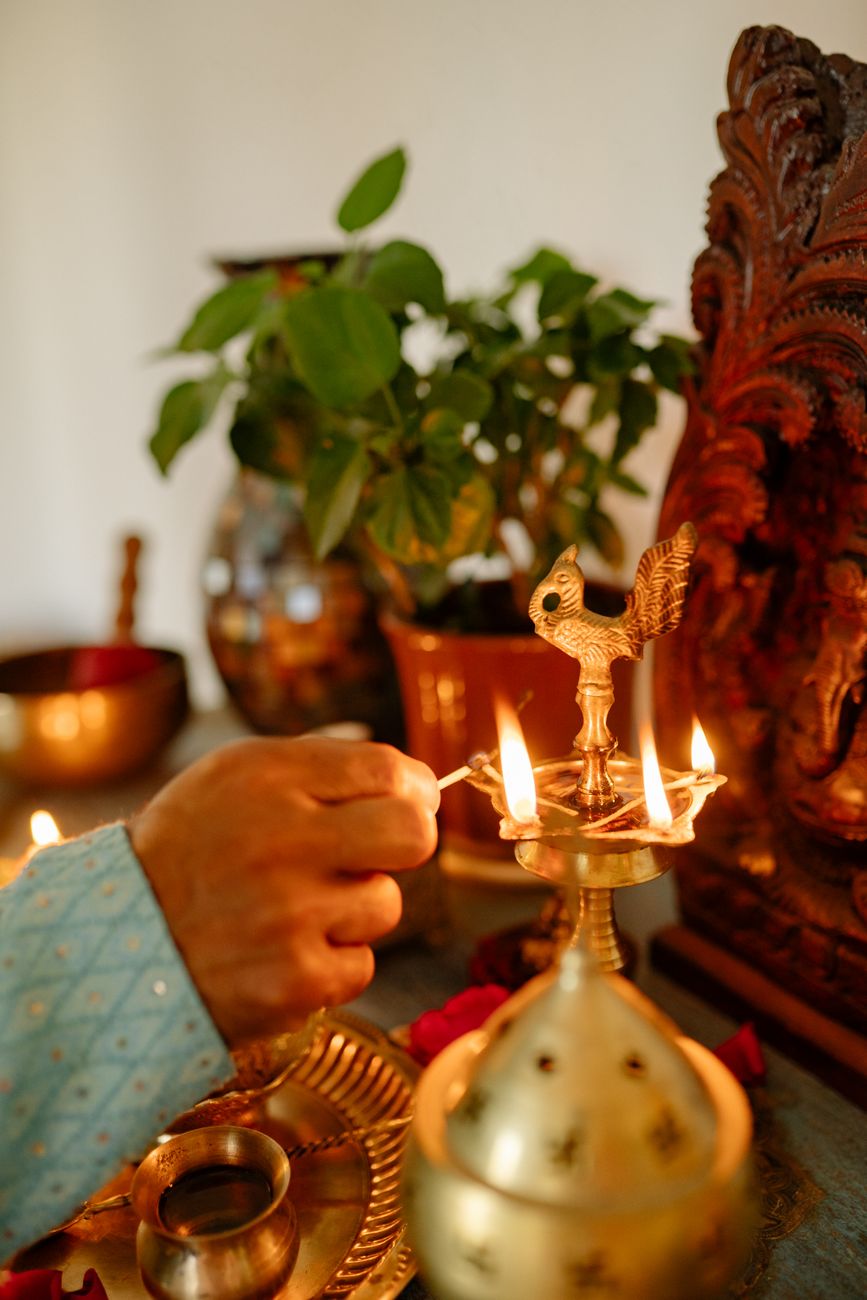
Light: a ghee diya for the main lamp, oil diyas for the rest of the house, incense, and camphor for aarti.
Other: a new broom, traditionally worshipped as a form of Lakshmi, cash or account books for Chopda Pujan, and any jewellery you wish to place before the deity.
The Vidhi, Step by Step
Before Sunset
Clean the entire house thoroughly. This is not incidental to the ritual but part of it, since Lakshmi is traditionally said to enter only where there is cleanliness and order. Bathe and wear clean or new clothes.
Set up the chowki facing east or north, spread the cloth, scatter rice, and place Ganesha on the left and Lakshmi on the right from your viewpoint as you face them. The idols should face east or west, with the worshipper facing east or north.
Establishing the Kalash
Fill the kalash with water, add the coin, supari and rice. Arrange five mango leaves at the rim and set the coconut on top. Place it to the right of the idols.
Beginning the Puja
Light the ghee diya and the incense. Perform achamana, sipping water three times. Take rice and flowers in your right hand for the sankalpa, stating your name, gotra if known, place and the purpose of the puja.
Ganesh Puja First
Offer haldi, roli, akshat, durva grass, flowers and a sweet to Ganesha, with the mantra Om Gan Ganapataye Namah. No puja in this tradition begins otherwise.
Lakshmi Puja
Bathe the idol with panchamrit if it is metal, then with clean water, and dry it. Offer new cloth or a thread, then haldi, roli, akshat and flowers. Lotus is the preferred flower where available.
Offer sweets, fruit, batasha and kheel. Light additional diyas.
Recite Om Shreem Mahalakshmiyei Namaha, traditionally 108 times, which is where a japa mala earns its place. Households that keep one often use a crystal maala reserved for the purpose.
Follow with the Lakshmi Chalisa or Shri Suktam if your family recites them.
Kubera and Chopda Pujan
Kubera, the treasurer of the gods, is worshipped alongside Lakshmi. Place your cash box, locker key or account books before the deities and offer roli and akshat.
For business owners, this is Chopda Pujan: the closing of the old ledger and the opening of the new. A Shree Yantra is traditionally kept with the books, and Diwali night is when it is placed.
Aarti and Closing
Perform the aarti with camphor, singing Om Jai Lakshmi Mata. Circle the flame clockwise before the deities. Ring a bell throughout.
Distribute prasad. Then light diyas throughout the house, particularly at the main entrance, in each corner, and near the water source. Leave the main door open for a period, since Lakshmi is said to enter through it.
What Households Commonly Get Wrong
Performing the puja before sunset. Lakshmi Puja belongs to Pradosh Kaal. Doing it in the afternoon because it is convenient misses the window entirely.
Skipping Ganesh puja. Ganesha is worshipped first without exception, and a puja that begins with Lakshmi is considered incomplete.
Using a broken or chipped idol. Damaged idols are traditionally not used in puja. If yours has chipped since last Diwali, replace it rather than making do.
Placing Lakshmi alone. The convention is Lakshmi with Ganesha, and in many households Saraswati as well. A solitary Lakshmi idol is unusual in practice.
Letting the diya go out early. The main ghee lamp is traditionally kept burning through the night, so use enough ghee and a wick that will last.
Leaving the puja space unclean afterwards. The offerings should be cleared the following morning rather than left for days.
If You Are Doing This for the First Time
The vidhi above is fuller than most households actually perform, and that is fine. Regional and family variations are extensive, and no two homes do it identically.
If you are setting up a puja for the first time and it feels like a lot, the essentials are these: clean the house, light a ghee diya after sunset, worship Ganesha then Lakshmi with roli, akshat, flowers and sweets, recite the Lakshmi mantra, perform aarti, and light lamps at the entrance. Everything else is elaboration.
A pandit is not required. Lakshmi Puja has always been a household ritual performed by the family, most often by the woman of the house.
Our Pooja Essentials and brass deity idols collections cover most of the samagri list.
Frequently Asked Questions
When is Lakshmi Puja in 2026?
Lakshmi Puja falls on Sunday, 8 November 2026, on Kartik Amavasya. The puja is performed after sunset during Pradosh Kaal, roughly between 6:00 PM and 8:00 PM depending on your city.
Can Lakshmi Puja be done without a pandit?
Yes. It has always been a household ritual performed by the family, most commonly by the woman of the house. No priest is required.
Which direction should the Lakshmi idol face?
Place the chowki facing east or north, with the idols facing east or west, and the worshipper facing east or north. Ganesha sits on the left and Lakshmi on the right as you look at them.
What should be kept in the Lakshmi Puja thali?
Roli, haldi, akshat, flowers, durva grass, panchamrit, sweets, fruit, batasha, kheel, a ghee diya, incense and camphor for the aarti. A kalash with water, a coin, supari, rice, mango leaves and a coconut is placed alongside.
Why is Ganesha worshipped before Lakshmi?
Ganesha is the remover of obstacles and is invoked first in every puja in this tradition. A Lakshmi Puja that begins without Ganesh puja is considered incomplete.
Should the main diya be kept burning all night?
Traditionally yes. The main ghee lamp is kept burning through Diwali night, so use sufficient ghee and a wick that will last until morning.
Before the Evening Comes
Most of what makes a good Lakshmi Puja happens before it starts: the house cleaned properly, the samagri gathered, the timing checked against a local panchang rather than assumed.
Our Diwali 2026 gifting guide covers the wider festival, and the Karwa Chauth 2026 guide covers the observance that precedes it.
Ritual practices described here follow common tradition and vary considerably by region and family. Follow your own family’s practice where it differs. Festival timings follow tithi and local sunset and vary by city.