✅ Authentic & Original Products | ⭐ Trusted by Thousands | 💵 Cash on Delivery | 🚚 Pan India Delivery | 🔒 Secure Payments
✅ Authentic & Original Products | ⭐ Trusted by Thousands | 💵 Cash on Delivery | 🚚 Pan India Delivery | 🔒 Secure Payments












Jyeshtha Gauri Puja 2026: The Three Days Explained
Jyeshtha Gauri Puja 2026: The Three Days Explained
Inside the Ganesh Chaturthi period sits a three-day observance that many households keep and many others have never heard of: Jyeshtha Gauri, when Gauri arrives, is worshipped, and departs.
Gauri Avahan: Thursday, 17 September 2026
Gauri Puja: Friday, 18 September 2026
Gauri Visarjan: Saturday, 19 September 2026
Note that Gauri Puja falls on the same day as the fifth-day Ganpati visarjan, which households keeping both need to plan around. Our guide to choosing a visarjan day covers the durations.
Who Gauri Is
Gauri is Parvati, Ganesha’s mother, and the observance is built on that relationship. In the traditional framing, Gauri comes to visit her son, which is why she arrives after he does and departs before the main visarjan.
In many households, particularly in Maharashtra, the Gauri are also identified with Mahalakshmi, and the observance is called Mahalakshmi Puja. The two identifications coexist and different families use different names for the same three days.
Usually two Gauri are installed rather than one, understood as sisters, Jyeshtha the elder and Kanishtha the younger.
Why the Dates Move Independently
Worth understanding, because it explains why Gauri does not fall on a fixed day of the festival.
Gauri follows nakshatras rather than tithis. Avahan falls on Anuradha, the puja on Jyeshtha, and the visarjan on Mula. Since nakshatras run on a different cycle from tithis, the Gauri days land at different points in the Ganesh period each year.
This is unusual. Most Hindu festivals are fixed by tithi, and our guide to nakshatras covers what they are and how the twenty-seven work.
The Forms Gauri Takes
This varies more by region and family than almost anything else in the festival calendar, and all the forms below are traditional.
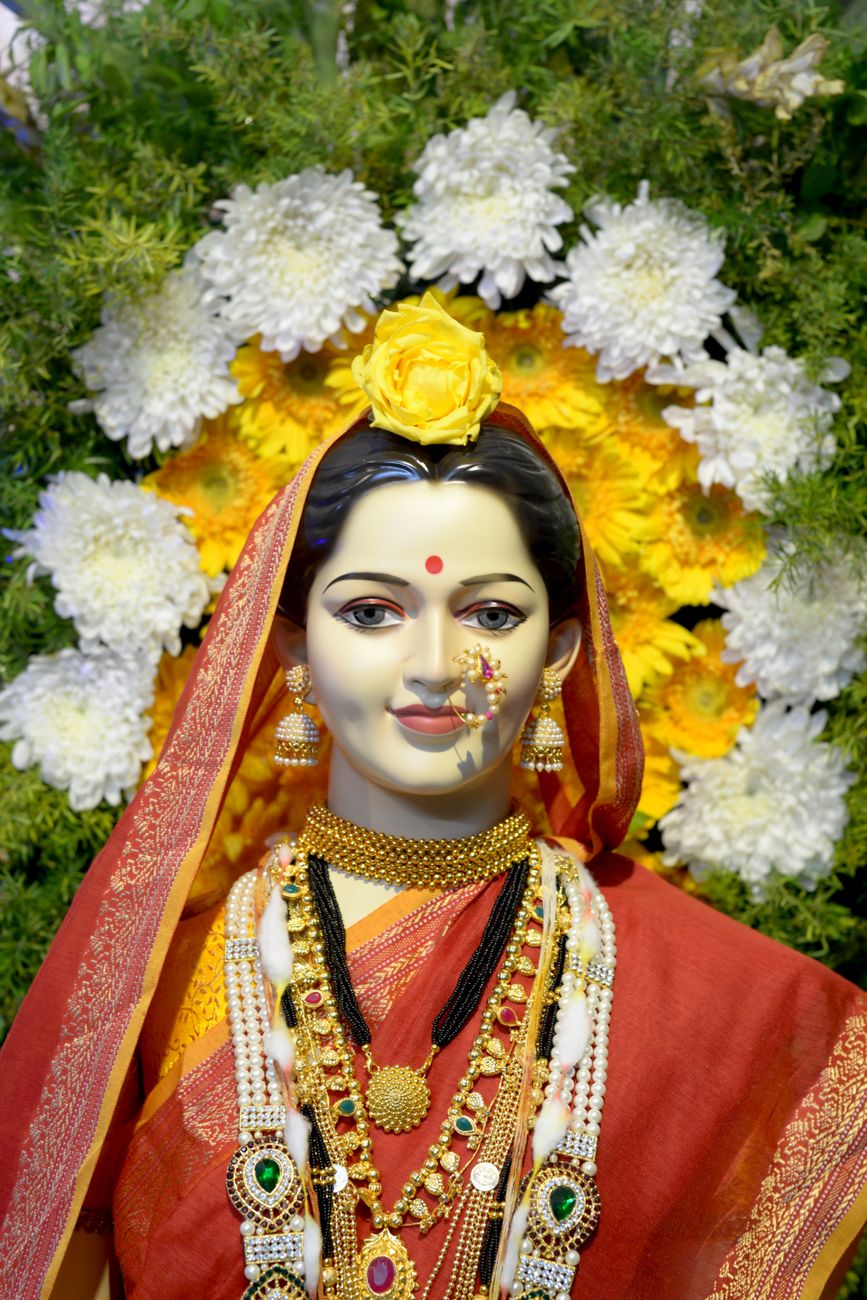
Masks on a frame, the most common urban form. Decorative faces mounted on a stand, dressed in sarees and ornaments so they stand as full figures.
Standing murtis, full idols in the same manner.
Khada Gauri, bundles of specific plants, often terda or other local species, gathered and dressed.
Stones, five or seven, brought from a river or field and installed. This is among the older forms and it is still kept in many families.
Kalash, pots installed and dressed.
Where your family has a form, keep that one. Where a household is beginning fresh, the mask form is what most urban families use and what is most widely available.
Day One: Avahan, Thursday 17 September
The arrival, and the day with the most distinctive customs.
The Gauri are brought in through the main door in the evening, and the arrival is treated as a guest arriving rather than an object being placed.
Footprints. Small footprints are drawn in rangoli or haldi kumkum from the doorway to the place of installation, marking the path Gauri walks in. This is the custom people remember most from childhood.
The murtis are paused at points along the way and asked what they see. The household answers on their behalf, naming what they wish for the home: grain, prosperity, children, wellbeing. The wording varies by family and it is worth asking an elder for yours.
They are taken through the house, often to the kitchen and the grain store, before being installed.
Installation near the Ganpati, usually to one side.
Our pran pratishtha guide covers the general installation sequence, and our guide to sacred symbols covers rangoli and the marks drawn at the threshold.
Day Two: Gauri Puja, Friday 18 September
The main day.
Solah shringar. The Gauri are dressed fully: saree, blouse piece, bangles, necklace, nose ring, bindi, kajal, flowers in the hair. This is the heart of the day and families put considerable care into it.
The puja follows the standard offering sequence, with red flowers, haldi and kumkum, and durva.
Naivedya is the elaborate part. The traditional Maharashtrian offering includes puran poli, bhaji of sixteen vegetables, karanji, ladoo, rice and varan. Regional and family variation here is enormous.
Sixteen recurs through the day, as in the sixteen shringar and the sixteen vegetables, in the way twenty-one recurs through Ganesh worship.
Haldi kumkum. Women of the neighbourhood are invited, given haldi and kumkum, and offered prasad. In many households this is the most social day of the whole festival.
Aarti in the evening. Our aarti guide covers the method.
Day Three: Visarjan, Saturday 19 September
A morning puja and the concluding offerings.
Uttar puja, the formal conclusion before immersion, exactly as with Ganpati. Our uttar puja guide covers the sequence.
Farewell with a request to return the following year.
What is immersed and what is kept depends on the form. Clay or plant forms are immersed. Masks and permanent murtis are cleaned, wrapped and stored for next year, since they are reused rather than immersed, and only the decorations and nirmalya are returned.
Our visarjan guide covers home immersion and the handling of nirmalya.
Storing the masks matters more than people expect, since they have to survive a year. Clean them, wrap in soft cloth, keep flat and dry, and store the ornaments separately. Our guide to storing and retiring sacred objects covers the general handling.
Common Questions
Can Gauri be observed without Ganpati? The two are usually kept together, since the observance rests on Gauri visiting her son. Some households keep Gauri alone and this is not unknown, though it is less common.
What if the Ganpati visarjan falls before Gauri? A household keeping a day and a half or three days will have concluded before Gauri arrives, and Gauri would then be observed separately or not at all that year. Households keeping Gauri generally choose a five-day or longer Ganpati observance for this reason, which is worth knowing before declaring the duration in the sankalp.
Is it only a Maharashtrian observance? It is strongest in Maharashtra and widely kept in Gujarat and parts of Karnataka, under varying names and forms.
Who performs it? The women of the household lead it in most families, and the haldi kumkum gathering is central to the day.
What if there has been a death in the family this year? Different rules apply and our guide to the festival during sutak covers the position.
Frequently Asked Questions
When is Jyeshtha Gauri Puja in 2026?
Gauri Avahan is Thursday 17 September 2026, Gauri Puja is Friday 18 September, and Gauri Visarjan is Saturday 19 September. The days follow nakshatras rather than tithis: Anuradha for the arrival, Jyeshtha for the puja and Mula for the visarjan.
Who is Jyeshtha Gauri?
Gauri is Parvati, Ganesha’s mother, and the observance is built on her coming to visit her son, which is why she arrives after he does and departs before the main visarjan. In many households the Gauri are also identified with Mahalakshmi. Usually two are installed, understood as sisters.
How are the Gauri murtis set up at home?
Forms vary by region and family. The most common urban form is decorative masks on a frame, dressed in sarees and ornaments. Others use standing murtis, bundles of specific plants, five or seven stones brought from a river or field, or installed kalash. All are traditional.
What happens on Gauri Avahan day?
The Gauri are brought in through the main door in the evening. Small footprints are drawn in rangoli or haldi kumkum from the doorway to the place of installation. The murtis are paused along the way and asked what they see, and the household answers on their behalf, naming what they wish for the home.
Are the Gauri masks immersed?
No. Masks and permanent murtis are cleaned, wrapped and stored for the following year, and only the decorations and nirmalya are returned. Clay or plant forms are immersed.
Can Gauri be observed if Ganpati has already been immersed?
A household keeping a day and a half or three days will have concluded before Gauri arrives. Households keeping Gauri generally choose a five-day or longer Ganpati observance for this reason, which is worth deciding before the sankalp.
Footprints From the Door
Of everything in the ten days, the small footprints drawn from the threshold to the puja space is the detail people remember from childhood, and it captures what the observance is: a guest being walked into the house and shown around.
Our first-time Ganpati guide covers the wider festival, our guide to choosing a duration covers planning around the Gauri days, and our uttar puja guide the conclusion. Our Pooja Essentials, brass deity idols and religious gift items cover the pieces, with cash on delivery across India.
Practices vary enormously by region, community and family, and Gauri observance varies more than most; follow your own household tradition. Dates follow nakshatra and vary by city; confirm timings against a local panchang.