✅ Authentic & Original Products | ⭐ Trusted by Thousands | 💵 Cash on Delivery | 🚚 Pan India Delivery | 🔒 Secure Payments
✅ Authentic & Original Products | ⭐ Trusted by Thousands | 💵 Cash on Delivery | 🚚 Pan India Delivery | 🔒 Secure Payments








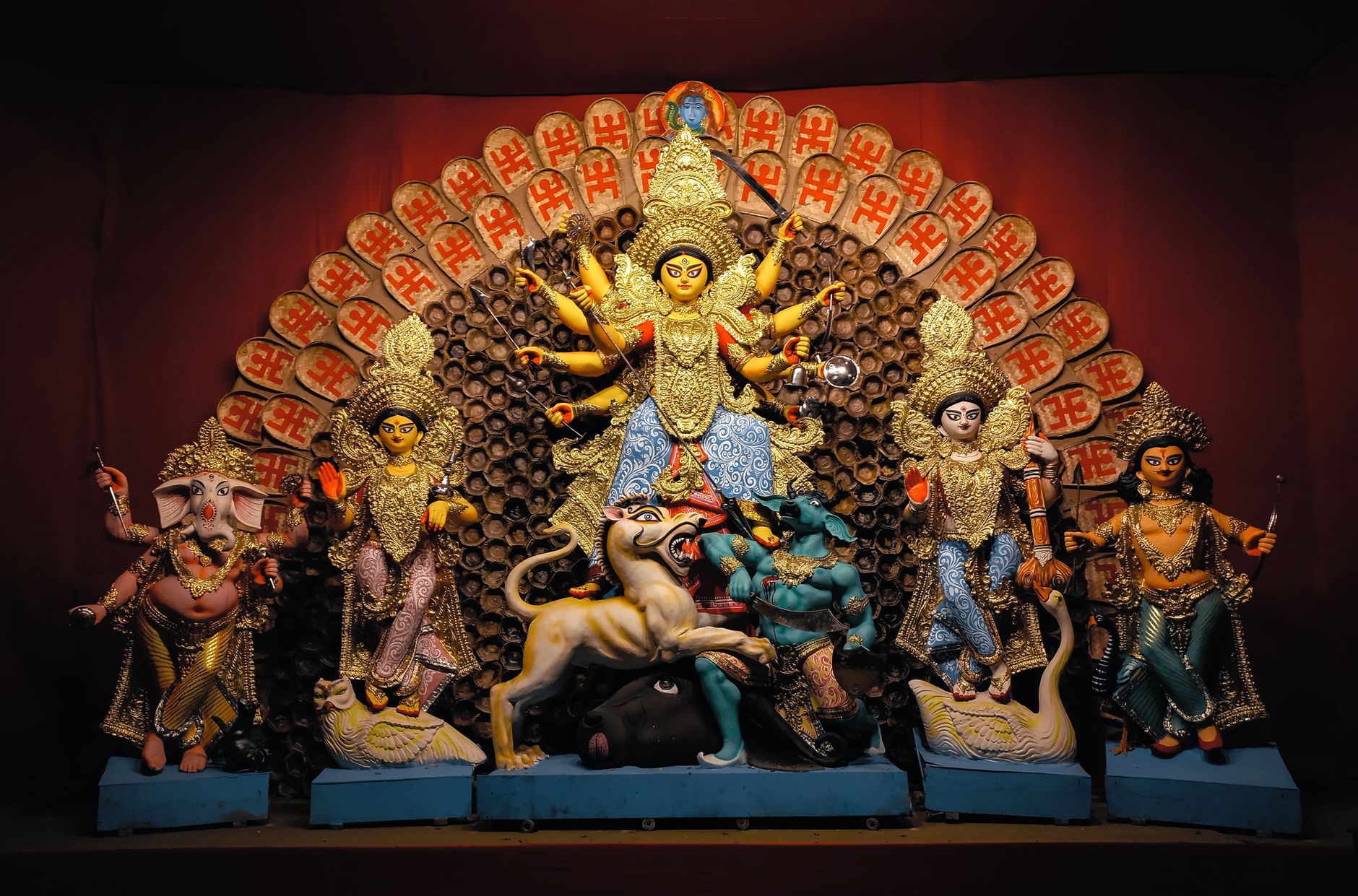
Durga Puja 2026: The Five Days, Sandhi Puja and Bijoya Dashami
Durga Puja 2026: The Five Days, Sandhi Puja and Bijoya Dashami
Durga Puja 2026 runs from Friday, 16 October to Tuesday, 20 October, from Shashthi through Bijoya Dashami. Mahalaya, which opens the season, falls on Saturday, 10 October.
It shares the calendar with Navratri and honours the same victory, but the observance is its own thing entirely. This guide covers the five days, what happens on each, and the rituals that belong to Bengal specifically.
Durga Puja and Navratri Are Not the Same Observance
Both mark Durga’s defeat of Mahishasura, and both fall in Ashwin. There the similarity mostly ends.
Navratri runs nine nights of fasting and worship of the nine Navadurga forms, beginning at Pratipada. Durga Puja concentrates into five days from Shashthi, is not primarily a fasting observance, and centres on the arrival of the goddess as a daughter returning to her parental home with her children, and her departure at the end of it.
That framing shapes everything. She is welcomed, fed, kept company and seen off. The grief at Dashami is the grief of a household after a visiting daughter leaves.
Mahalaya: 10 October
Mahalaya falls on the Amavasya that closes Pitru Paksha, six days before the puja begins.
It opens with the pre-dawn recitation of Mahishasura Mardini, broadcast since 1931 and still listened to at four in the morning across Bengal and the diaspora. Tarpan is offered to ancestors at the riverbank.
It is also traditionally when the eyes are painted onto the idols, the chokkhu daan, and the moment the goddess is said to begin her journey home.
Shashthi: Friday, 16 October
The goddess arrives.
Bodhon is performed, the ceremonial awakening. The face of the idol, kept covered until now, is unveiled. Amantran and adhibas follow, the invitation and the consecration.
The pandals open in the evening, and pandal hopping begins in earnest, running through the following four nights.
Saptami: Saturday, 17 October
The day begins early with Nabapatrika snan, at dawn, at a river or water body.
Nine plants are bound together with a banana plant at the centre, draped in a red-bordered white sari, and bathed. This is the Kola Bou, and the nine plants represent nine forms of the goddess. She is then installed beside Ganesha.
The popular reading of the Kola Bou as Ganesha’s wife is a later folk addition; the ritual meaning is the nine-fold form of Durga herself.
Pran pratishtha follows, and the first full puja is performed. Anjali begins.
Ashtami: Sunday, 18 October
The largest day, and the one most people attend.
Pushpanjali is offered in the morning, flowers held in cupped hands while the mantras are recited collectively. Queues form well before it begins.
Kumari Puja is performed in some pandals, where a young girl is worshipped as the living goddess, a practice associated with Belur Math.
Sandhi Puja is the ritual centre of the entire festival. It falls in the 48-minute window spanning the last 24 minutes of Ashtami and the first 24 of Navami, marking the moment Durga assumed her Chamunda form to kill Shumbha and Nishumbha. 108 lamps are lit and 108 lotuses offered. The timing is fixed by tithi rather than by clock, so check your pandal’s announced time.
Navami: Monday, 19 October
The Maha Navami puja and homa are performed, and the last full day of the goddess’s stay.
Navami bhog is the most elaborate meal of the festival: khichuri, labra, beguni, chutney and payesh, served to everyone who comes. Community feeding is central to Durga Puja in a way it is not to most festivals, and the bhog queue is part of the experience.
The mood on Navami evening is distinctly different from the earlier nights. Everyone knows what tomorrow is.
Bijoya Dashami: Tuesday, 20 October
Darpan visarjan is performed in the morning, the immersion seen in a mirror rather than directly, a gentler formality before the actual farewell.
Sindoor khela follows. Married women offer sindoor to the goddess and then apply it to one another, and the practice has broadened considerably in recent years, with many pandals now opening it to all women.
Visarjan in the afternoon and evening, the idols carried in procession to the river.
Dhunuchi naach through the day, danced with earthen censers of burning coconut husk and camphor, one in each hand and sometimes a third held in the mouth.
Then Bijoya itself: elders touched for blessings, embraces exchanged, sweets distributed, and the greeting Shubho Bijoya carried through the following days as people visit.
Pandal Hopping
The public art of Durga Puja deserves its own mention. Kolkata’s pandals are large-scale temporary architecture, built by named artists on themes announced in advance, and the city stays awake for four nights walking between them.
The tradition travels. Durga Puja committees run substantial pandals in Ahmedabad, Surat, Delhi, Mumbai and Bengaluru, and the diaspora pujas are increasingly ambitious.
Practical advice unchanged in fifty years: go late, wear shoes you can walk five kilometres in, and eat where the queue is longest.
For the Home Puja
Households keeping a domestic observance alongside the pandal usually keep something permanent in the puja space.
Our brass deity idols and Pooja Essentials collections cover the usual requirements. For anyone marking the occasion with something worn, our crystal bracelet range and the Navratri crystals guide match stones to each of the nine forms.
Frequently Asked Questions
When is Durga Puja 2026?
The puja days run from Shashthi on Friday, 16 October to Bijoya Dashami on Tuesday, 20 October 2026. Mahalaya falls earlier, on Saturday, 10 October.
What is the difference between Durga Puja and Navratri?
Both mark Durga’s victory over Mahishasura. Navratri runs nine nights of fasting and worship of the nine Navadurga forms from Pratipada. Durga Puja concentrates into five days from Shashthi, is not primarily a fasting observance, and centres on the goddess arriving as a daughter at her parental home and departing at Dashami.
What is Sandhi Puja?
The ritual centre of Durga Puja, performed in the 48-minute window spanning the last 24 minutes of Ashtami and the first 24 of Navami, marking the moment Durga assumed her Chamunda form. 108 lamps are lit and 108 lotuses offered. The timing is fixed by tithi rather than clock.
What is the Kola Bou?
Nine plants bound together with a banana plant at the centre, draped in a red-bordered white sari and bathed at dawn on Saptami. The nine plants represent nine forms of the goddess. The popular reading of her as Ganesha’s wife is a later folk addition.
What is sindoor khela?
Performed on Bijoya Dashami, when women offer sindoor to the goddess before immersion and then apply it to one another. Traditionally kept by married women, it has broadened in recent years and many pandals now open it to all women.
What bhog is served during Durga Puja?
Khichuri, labra, beguni, chutney and payesh are the standard bhog, served to all comers, with Navami bhog the most elaborate. Community feeding is central to Durga Puja in a way it is not to most festivals.
Aschhe Bochhor Abar Hobe
Durga Puja ends the way it does because of how it is framed: not a deity departing, but a daughter going back. Which is why the last words said at the river are that next year it will happen again.
Our Navratri 2026 guide covers the parallel observance, and the Dussehra guide covers Vijayadashami elsewhere in the country.
Shubho Bijoya.
Ritual practices vary by region, community and puja committee; follow your own tradition where it differs. Sandhi Puja and other timings are fixed by tithi and announced locally. These products are not intended to diagnose, treat, cure or prevent any medical condition.